
A glance at Venezuela’s history in the last few decades
As a child, I always listened to my grandmother and parents tell stories of what Venezuela used to be like. “We were the fourth richest country in the world. The bolivar was worth more than the dollar!” they said. “Everyone came to Little Venice in search of prosperity…” My generation never experienced that. It sounded like a myth that tried to keep our desire to survive alive.
In the early hours of Jan. 3, 2026, all over the world, tricolor lights from the souls of every Venezuelan emigrant lit up the night as they heard the news. Nicolás Maduro Moros, the dictatorial president of Venezuela, had been captured by the United States.
The 8 million Venezuelans who were forced to emigrate cried, shouted and danced with both excitement and gratitude. Those who remained at home celebrated quietly so as not to be persecuted. We were all united in that small ray of faith that saved us from the terror cultivated over two decades.
Although this is not the first dictatorship—nor the only cruel one—that Venezuela has experienced, it was the only one that destroyed the country. In fact, many Venezuelans today remember the early 20th century’s Juan Vicente Gómez and Marcos Pérez Jiménez, two of the country’s greatest dictators, with gratitude rather than resentment.
Both were known for ruling with terror and oppression, for circumventing the system more than once to stay in power and for constantly stealing money from the people. The difference is that, for better or worse, they made the country progress.
Gómez enriched the country by signing oil business with the United States and European countries. Meanwhile, Pérez Jiménez promoted public works such as highways, hospitals, etc.
Although they took advantage of the people, both brought some stability to the country. On the other hand, Maduro and his predecessor Hugo Chávez, under the guise of democracy, burned everything down.
Chávez was a communist military lieutenant who was very popular among the poor and uneducated people suffering from inflation and unemployment caused by an economy dependent on the nationalized oil sector. They saw hope in him and elected him president in 1998.
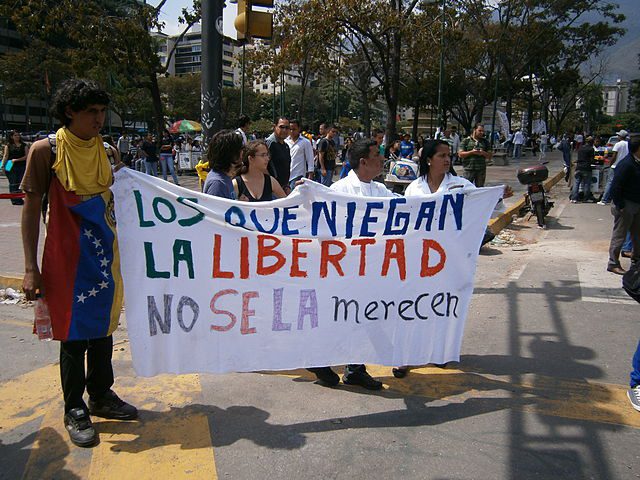
Once in power and with the approval of the people, Chávez rewrote the country’s constitution, increasing the length of his term in office, among other changes. However, the people were outraged when the government began nationalizing businesses throughout the country. There were protests, murders of civilians by Chávez and a failed attempt to remove him from office.
By 2006, the government had once again taken complete control of the oil industry and had nationalized banks, manufacturing, media and businesses. Moreover, they implemented price and currency controls and began seizing private land to give to the poor.
He committed fraud in the 2012 elections, in addition to ruthlessly imprisoning opposition leaders and controlling the press. The following year, he died of cancer and left Maduro as his successor, who was elected president through fraud.
Since then, with the fall in global oil prices, Venezuela’s economy has entered a serious crisis and the currency has been devalued. However, Maduro and the regime have manipulated the bolivar to only enrich themselves. Therefore, for the rest of the country, the bolivar has no value, which makes it difficult for Venezuelans to purchase basic items such as medicine and food.
In addition, due to price controls, many businesses closed, leaving the population with no resources. Necessities such as electricity and water were an uncertainty for us. It became such a habit that we reached the dystopian reality of receiving a schedule from the government of when we would or would not have electricity and water.
From opposition leaders to university students, many have tried to remove the regime from power. But the government’s abuse of the military, which has cold-bloodedly murdered children, women and even the students and imprisoned thousands of politicians, subjecting them to inhuman torture, has gradually caused the opposition to sell out or simply disappear.
Meanwhile, the socialists continue to line their pockets with the money of the poor, whom they deceived with the vile lie of wanting to help them. Their goal was simple: to keep the poor impoverished and take advantage of their ignorance.
But faith returned in the 2024 elections, with the strategy of Nobel Prize winner and opposition leader María Corina Machado to print the voting records, which left the world speechless and the regime afraid. Machado gained worldwide support to overthrow them, including from the United States, bringing us to the present.
It is uncertain what will happen to Venezuela from now on. Many attempts have been made to regain freedom, and all have failed. The country fell into economic poverty, perhaps paradoxically because of its wealth of resources. Or perhaps because of the educational poverty of the people.