
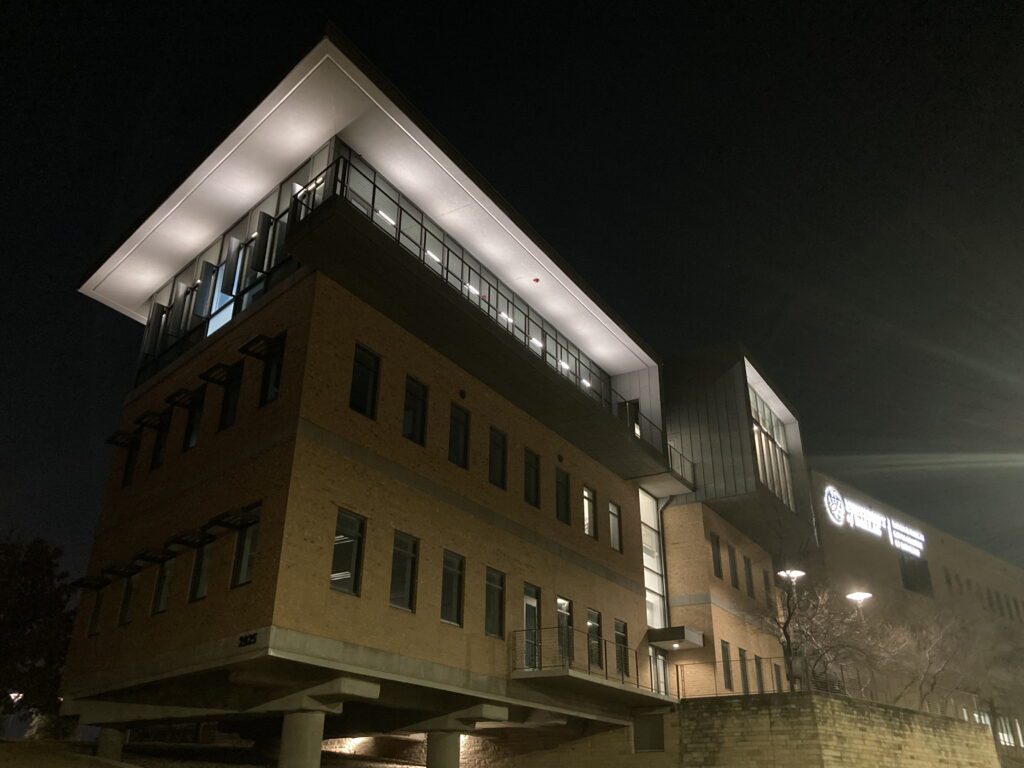
Against the reign of the technocratic in art
At the end of last semester, an article was published in this paper defending modern art in principle, if not always in practice. While the defense was qualified, it nevertheless dismissed the most important principles in judging the fine arts, namely, the three transcendentals: the true, the good and the beautiful.
The article distinguished between art requiring technical talent and “conceptual art,” generally limiting its defense to the former. I propose that we further distinguish skilled art into three categories: 1) beautiful art in the fullest sense, 2) good art lacking beauty because it portrays something ugly or evil, though it does so in accord with the truth and 3) skilled art glorifying something evil or ugly or portraying something good in an ugly way. Contemporary aesthetic styles, I argue, generally fall into either the second or third categories, but more often into the third.
What is beauty? Unfortunately, Catholic institutions since the 50s have largely failed to explain and defend beauty. Last year, my instinctive dislike for the style of the Haggar and Capp Bar renovations prompted me to try to articulate to myself a rational explanation of what makes something beautiful or ugly. However, after three years of studying at a Catholic liberal arts university, I found myself completely at a loss! UD’s renowned core curriculum had never even attempted, to my memory at least, to explain the nature of beauty!
Fortunately, I was not left helpless. On a “Word on Fire” podcast episode from last summer, Bishop Robert Barron—following Aquinas—explained that beauty is “the intersection of three things. In [Aquinas’s] Latin: integritas, consonantia and claritas.” Bishop Barron translated these as “wholeness,” “harmony” and “radiance.”
Integrity or wholeness, as Barron describes it, simply means that the thing “exists as one thing,” where the parts contribute to a coherent whole. Harmony is similar, consisting in a well-ordered relationship of the parts with each other. Claritas, or radiance, in a literal sense, means a physical brightness or colorfulness, but on a deeper level it refers to a “clarity of form.” In the beautiful, “the form of something shines forth.”
Barron notes that all three transcendentals, including beauty, are qualities that “apply to being as such.” In other words, everything that exists has them. Is one unable, then, to objectively distinguish between ugly and beautiful things? On the contrary. After all, evil is no more than a lack, an absence of good, yet it is still an objective standard of judgement. Following this logic, some forms of art, while they may have a certain beauty insofar as they exist, are ugly because they lack, to a greater or lesser extent, integrity, harmony or radiance.
Some art, such as pieces attempting to express the evils of war, may lack a certain fullness of beauty by their very fidelity to the thing they portray. Contemporary pieces of this nature often lack harmony or physical radiance. However, they can still have the deeper radiance that makes clear the form of the thing being portrayed. Though that form is itself deformed, the artwork portrays it as evil, in accordance with the nature of reality.
Though such pieces can be ugly due to their lack of harmony, I would argue they can still be good art. Their value, however, lies in their message rather than in the beauty of the pieces themselves, and to use them as decoration as if they were beautiful would go against their purpose.
I agree, then, that one cannot reject all contemporary art out of hand, even if its appearance is disorderly or ugly. However, contemporary art in general minimizes its representation of beauty notbecause it aims to reveal the truth about some evil, but rather to obscure it.
Often, such art explicitly attempts to “overcome the boundaries” between truth and falsehood, good and evil, beauty and ugliness. In truth, such styles as cubism, abstract paintings and futurist sculpture and architecture in effect advocate a false philosophy, namely, what Pope Francis called modernity’s “technocratic paradigm.”
As Pope Francis describes in the encyclical Laudato Si’, the technocratic paradigm is a worldview in which man, viewing nature as mere “raw material to be hammered into useful shape,” “declares independence” from and seeks “absolute dominion” over the natural world, over human nature and ultimately over the nature of all reality.
The article to which I am responding puts forward in defense of modern art one student’s view that through art, “you’re able to superimpose your will over reality in a way that’s real, more real than real life.” While this argument may not have been meant in this way, the claim could easily be taken to suggest that the “reality” that is most “real” is not God’s created order but the imposition of our own supreme will upon the “raw material” of nature. Ironically, interpreted this way, the claim aptly describes the aims of much of contemporary art.
The Futurist style of architecture provides a revealing, albeit rather extreme, example. Originating in early 20th century Italy, Futurism embraces modern materials such as steel and concrete and intentionally contradicts traditional principles of harmony and integrity through misplacement, randomness, unusual shapes or the like.
Futurism embodies the technocratic paradigm in its final stage, the rebellion against all received order. According to Encyclopedia Britannica, Filippo Tommaso Marinetti, the man who coined the term, explicitly intended to repudiate the past and glorify technology, innovation, movement, power and violence. Unsurprisingly, he went on to become a fascist. And, also unsurprisingly, the style was widely embraced by postwar liberal modernity. It has become so widespread that its influence can even be seen in UD’s own Cardinal Farrell Hall and SB Hall.
Other modern architectural styles embody this paradigm’s more moderate form, the conquest of man over non-human nature. One example is brutalism, the mechanical, dull factory-like style of the immediate postwar period, embodied to a certain extent in some of UD’s older buildings, particularly the freshman dorms. Another example is the contemporary sterile, corporate style that gives one the impression of an office or “airport lobby,” a style exemplified all too well by Frassati’s and the renovations to the Capp Bar.
Different as these two styles may seem, they ultimately share the same paradigm. The former exalts the war against nature itself through the machine, while the latter exalts the victory, a sterilized, whitewashed world.
We don’t have to settle for the modern aesthetic. Compare Frassati’s with the beauty of our Due Santi campus. Even the moderately traditional style of the buildings there create such a warm, friendly and natural atmosphere that I think I can say that our campus abroad feels more homelike than UD’s home campus.
We must face the unhappy truth: the University of Dallas has largely overlooked beauty. All of us, whether students, professors or administration, cannot let ourselves grow so used to our campus architecture that we come to think that a lack of beauty is unimportant. Modern art and architecture is not merely a “different window into reality,” but a window into an unreality. An institution dedicated to truth has no need for false windows. But it could certainly use some stained-glass ones.