
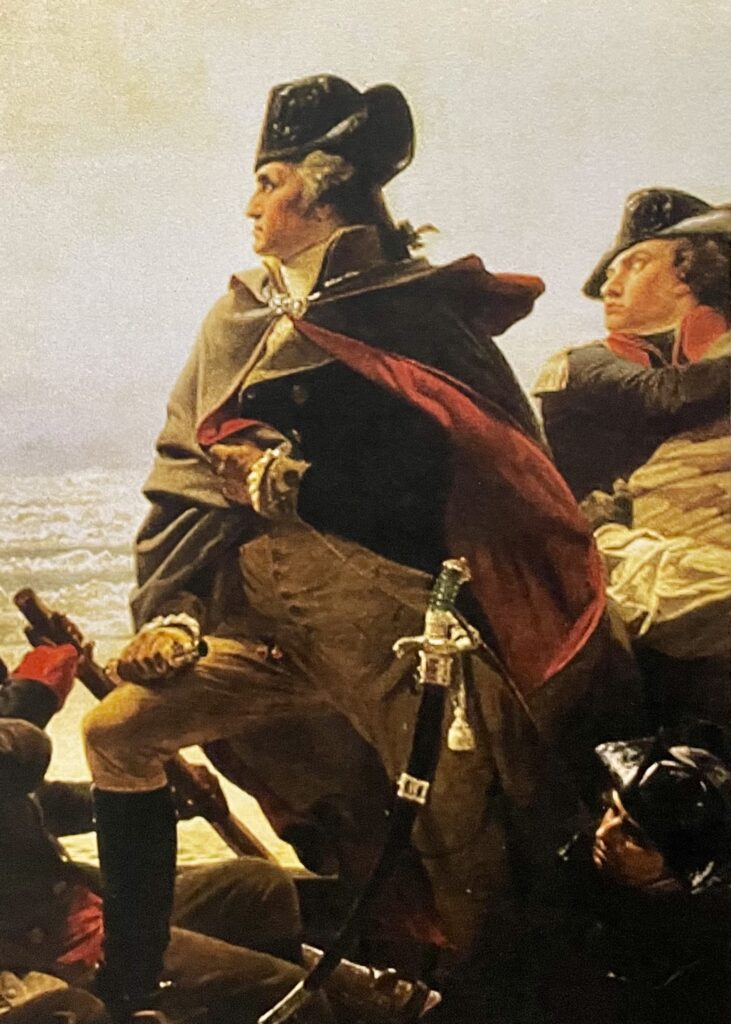
Washington’s Example for the American People
For 250 years, our country has enjoyed many blessings of prosperity, prominence and praise, despite many challenges—and many mistakes—we today enjoy the blessing of our country. To celebrate and commemorate our 250th anniversary as a country, I hope, in a series of articles, to examine our national character through some national characters, to assist in the self reflection which behoves one who is growing old.
Where else to begin but Washington, whose birthday was this past Sunday, and brought our nation into existence–albeit accidentally? Washington, whose confession to murdering French commander Joseph Coulon de Jumonville—partly out of his inability to read French and understand Dutch—led directly to the French and Indian war, which laid the foundation for the revolution in 1776.
This man, one of our most revered national heroes, has many lessons for us, but I’d like to focus on two. First: we are going to make mistakes that will need remedy.
Washington was never the most brilliant tactical commander, and while he was a skilled political operator, he nevertheless had difficulties in leading a new government through exceptionally tumultuous times. His mistakes even led to the 7 years war, and eventually America’s birth, but also to the eventual fracture of his cabinet over party politics.
Washington, although he wasn’t perfect, exemplified the virtues that best accounts for such mistakes: perseverance and prudence. Washington, even after being outmaneuvered by British field armies, after mutinies and coups, after the first American government—under the Articles of Confederation—was deemed inadequate, nevertheless continued to serve his country, enduring the costs and the calumny while pursuing solutions.

We ought to remember that we Americans are only exceptional in our circumstances, not in our being. We are still fallen men, with great capacity for good as well as evil that must be addressed and accounted for.
We will make mistakes, and will have to endure great costs because of some of them; what we need is the grace and grit to endure such things in order to see the favorable things that come after suffering. There is one more virtue that we must examine, which is Washington’s willingness and humility to listen.
One of Washington’s most seminal victories, Yorktown, was the result of the advice of Marshal Rochambeau, who told our first president that Cornwallis’ position in Virginia was an easy target compared to what it might be in New York, Washington’s initial vector of attack. Washington practically relied on the advice of his cabinet ministers, such as Hamilton, Madison, Jefferson, et al. to provide him with much needed counsel on matters of policy and diplomacy.
Without Madison’s guidance, Washington might have remained in retirement, and our nation would have had to wade murky and uncertain waters to find a capable and considerate leader. We, as inheritors to this country and the duty of leading and stewarding it, should remember the wisdom that can be found in our fellows if we only take the time to look.
It’s no easy thing to follow our forefathers, especially when they climbed so high the peaks of virtue. Yet we, for the sake of our country, and for our countrymen both breathing and yet to be begot, ought to strive to follow.
David Dainko is a Freshman history major, as well as a regular participant in the Greg Hall nightly rosary.