
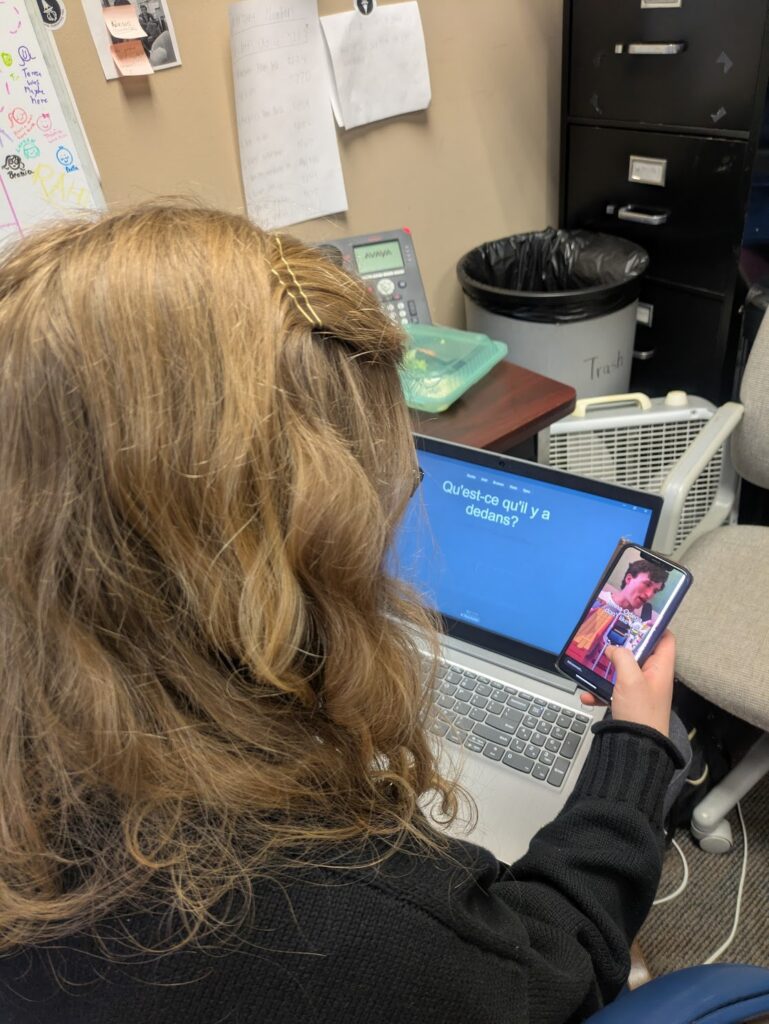
Are you using your phone or is your phone using you?
I recently read an article claiming that 2026 is “the year of analog.” A quick internet search revealed that “going analog” is, ironically, trending on social media.
I understand why. I’ve felt the greatest freedom on days where—due to a retreat or personal challenge—I didn’t have my phone. Because of this, I’ve been cutting down my time online for a couple of years now, and in a more focused way this winter.
But, anecdotes aside, why cut down on technology use? According to various studies, excess technology use can negatively impact your attention span, sleep, mental health and even brain structure.
An article from Ox Journal, examining how technology affects the attention span, said, “[M]ultimedia multitasking […] has been shown to significantly decrease the ability to concentrate for sustained amounts of time.” The article continued, “[a 2014] study […] discovered that the ‘mere presence’ of a mobile phone produced ‘diminished attention and deficits in task-performance.’”
The National Sleep Foundation says that the blue light emitted from devices can negatively affect sleep.
“Blue light has shorter wavelengths than other colors […] and causes more alertness than warmer light tones. Because blue light promotes wakefulness, it can have a powerful effect on the natural sleep-wake cycle […] Exposure to blue light at night stimulates your brain into thinking it’s earlier in the day [and] stops its release of melatonin, making it harder to fall asleep.”
This is why so many people recommend staying off screens at least an hour before bed.
Technology use also has negative effects on mental health and even brain structure. A 2019 study says that “Increased screen time is associated with […] lowered self-esteem, increased […] mental health issues and addictions, slowed learning and acquisition, and an increased risk of premature cognitive decline.”
Despite knowing the scientific reasons excess technology use has negative effects, it’s hard to reduce screen time. As the article from Ox Journal saide, “[Social media] provides users with a dopamine reward; as users scroll and swipe, they get a hit of dopamine, which over time creates an addictive pathway that inhibits impulse control.”
The way to break free from excessive technology use is to take steps to make it less addictive and to have boundaries about when and where you use it.
One way I recommend reducing the time you spend staring at pixels is to delete social media on your phone. Using social media on the computer instead makes scrolling less enjoyable and therefore less addictive. I started doing this a couple years ago and love how it makes checking social media into a purposeful action rather than a mindless scroll.
Another way is to put your phone into grayscale or reduce the color saturation. The bright colors are part of why it sucks you in–so reducing the color can help it be less addictive.
I tried turning my phone grayscale once, but my brain started thinking I was seeing in black and white when I looked at gray things in real life. That was too trippy for me, so instead I just turned down the color saturation, which still had the desired effect. Also, making my phone’s colors less vivid made the colors in real life start to appear more vivid, a perception which I hadn’t even known my phone affected!
Another important tip to avoid distractions is to limit notifications. Some smart phones allow you to customize your do not disturb settings, setting up various focus settings which only allow certain notifications. Setting these up to reduce the volume of notifications you receive, while still receiving those which might be urgent, is really helpful.
Alongside this, another thing I found helpful is that I turned off the sounds and vibrations for all my notifications except phone calls. My friends and family know that if they need to reach me urgently, they can call me.
Finally, I disabled push notifications and notification badges for any app that wasn’t a messaging app, including email, meaning I had to purposely go check those apps. This further limited the number of distractions popping up.
At UD, we talk a lot about how to achieve a life well lived (“Eudaimonia”) and part of that is living a well ordered life. My purpose in all of this is not that I hate technology altogether, but that I want to keep it in its proper place, where it is a tool that helps me rather than an addiction which hinders me. As Dr. Mr. Berry would say, technology should be a tool that we use, not one that uses us.
Christi Bales is a senior English major and a Women of the Word mentor.