
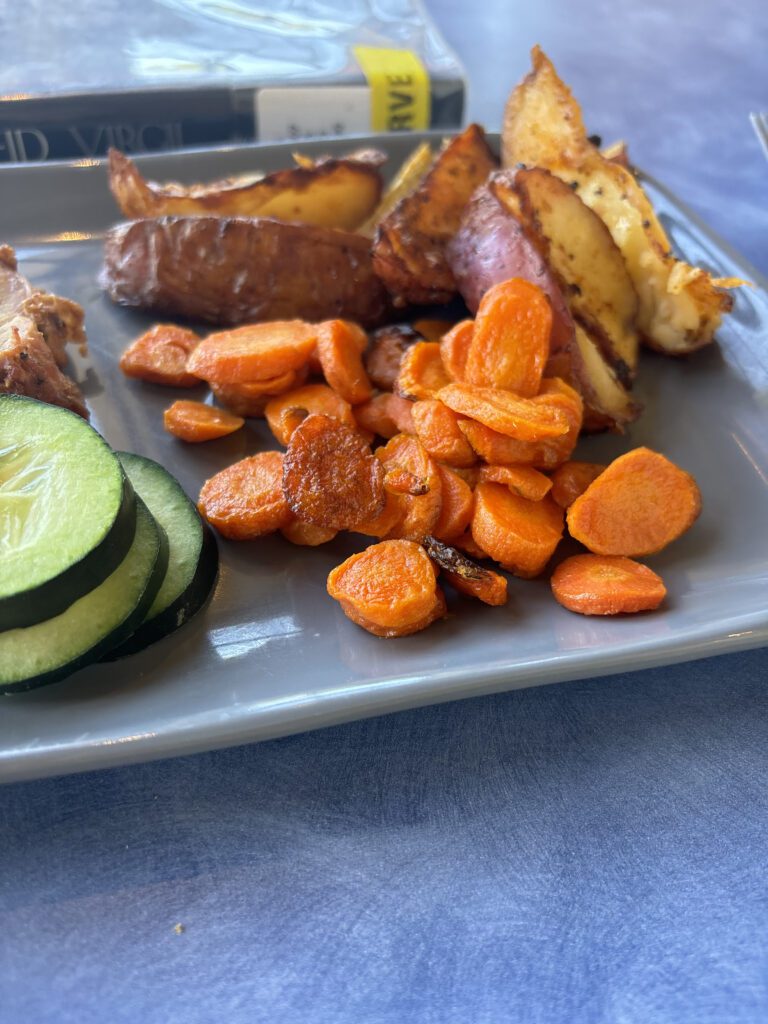
A UD student’s years at the Haggar Cafe are a rite of passage earning them the status of an upperclassman. While ensuring the quality of dining hall food in bulk is a complex matter at every stage, there are some basic ways in which some students believe UDallas Dining Services has failed the roughly 1000 students who rely on the Cafe for their daily meals.
Charlotte Anderson, freshman politics major, found a small worm in her broccoli at the beginning of the semester: “[It] was just very gross.”
Anderson sent a photo of the worm to cafeteria general manager Casey Teng, who subsequently reached out to the produce vendor on Anderson’s behalf, promising her they would switch to frozen broccoli in the meantime.
However, Anderson contacted Aramark again a week later after finding a silverfish in her pasta and wound up speaking to the head chef.
“They told me that the nasty critters come from the food vendors, not from Aramark,” Anderson said. “They said they haven’t had a problem with anything like this in six years, and it’s crazy that it happened to me twice in two weeks. They said broccoli worms [happen] every year just naturally, [but] the silverfish I was less convinced about. Their theory was it was stuck to the inside of a pasta noodle and fell out once they cooked it.”
Despite her concerns with the food, Anderson complimented the employees she was in contact with. “Overall, they were very friendly,” said Anderson.
The dining staff gave Anderson some suggestions about what to request to be able to have fresher food. “You can ask the grill master to sautee your veggies from the salad bar, and if you really want pasta, they can cook you some in the back, especially if they’re using it for a meal later that day. [You can] just email them or let the kitchen supervisor person know if you want something specific.”
Anderson is not the only student who found an insect in her food. David Dainko, a freshman philosophy major, recalled an unlucky incident: “I got some broccoli one evening. I was looking closely at it and I found two mayflies, one that looked—I don’t know if it was dead, but it was in stasis. And the other one was black.”
Beyond insects, other students have concerns about sanitary practices from dining staff and consequent contamination issues.
Freshman drama majors Clare Kelsch and Marley Cook recounted one instance: “It [was personal] pizza day,” said Cook. “The lady [took]the pizza [out of the oven] and slice[d] it and hand[ed] it to the girl whose it was. The girl had a green box, [so the worker] took the plate that had the pizza on it, used the same rag to wipe off her hands and the plate, and put the next pizza on that plate.”
Kelsch had a concerning experience at the Deli station when she ordered a sandwich. “As I walk up, [the worker at the sandwich station] is taking a piece of ham and eating it. I order what I want, and as they are handing it to me, they are still chewing this ham. I [saw] a little piece fly off and land in my food. [My sandwich] is handed to me with a little piece of slime slobbery ham sitting atop. I did not eat that.”
Freshman biology major Hannah Kidd simply noted, “I have to check if the chicken is pink.”
Some students have expressed that UDallas Dining has failed to sufficiently provide for students whose allergies make nourishment difficult enough already. Even the “True Balance” station does not always supply students with sustenance that is safe for them to eat.
An individual on the meal plan with severe food allergies, who wished to remain anonymous, said, “When you are a university dining hall, you are required to serve people with all sorts of allergies, so you have to be equipped to actually serve those people.”
The student continued, “[Aramark is] so defensive, which makes sense, but they will not listen to you saying, ‘This is a problem.’ They say they can accommodate you in theory, but in practice, [when] you try to implement those workarounds… you can’t.”
Some students have indicated that the Cafe situation seems unfixable, especially since Aramark’s contract with the University is set to last 20 more years. However, the staff expressed a genuine willingness to work with students and administration.