
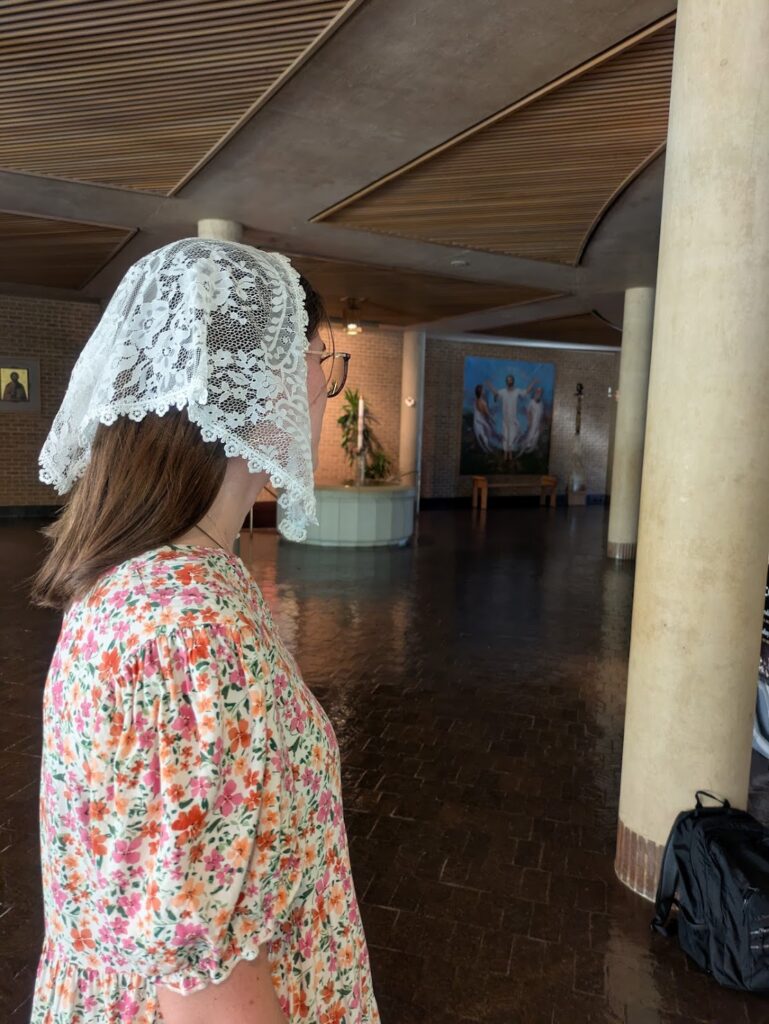
Why is this devotion making a comeback?
Since the liturgical and cultural shifts in Catholicism following the Second Vatican Council, the practice of veiling during Mass has been a somewhat sensitive and controversial topic within the American Church.
The mandate for women to cover their heads, which had been enshrined in the 1917 Code of Canon law (along with the requirement that men be bareheaded during the liturgy) was not renewed in the 1983 revision. This alteration, along with the general liturgical upheaval of the 1970s and 80s, resulted in a stigma surrounding the practice of veiling.
Veiled women who attended or visited progressive parishes were asked to remove their veil, while more traditional parishes doubled down and handed out head-coverings at the door to ensure that all women were veiled. At typical, middle-ground parishes, veiling just quietly dropped out of practice.
But veiling is making a comeback.
In the last 15 years or so, many Catholic women, particularly young women, have taken up the practice of veiling. Since veiling fell out of common practice in the 80s, it has been typically associated with very liturgically traditional parishes. But, interestingly, this comeback in veiling is not limited to the more traditional Catholic communities. Women from traditional and charismatic backgrounds alike are making the decision to veil.
Why is this practice experiencing a renewal in the Church today?
I believe that the increase in veiling among Catholic women is due to a shift in how the practice is being perceived: from a stale, left-over requirement that some women choose to follow into a voluntary devotional practice and aid to worship.
Contrary to popular belief, the repeal of the veiling mandate in the 1983 Code of Canon Law was not in fact changing a centuries-old requirement of the Church. Veiling was never mandated by the Church until 1917. For the almost 2000 years of Church history before 1917, veiling was not legally required by canon law– it was merely a widespread practice. Veiling has only ever been mandated between 1917 and 1983, for a brief 66 years, before the Church discerned that it ought not be a legal requirement. It is, in fact, not the norm for veiling to be required.
I argue that the recent renewal in veiling is in fact a delayed response to the 1983 revision of canon law. Although the immediate effect of this change was a loss of the practice of veiling, it is also the reason that veiling has reappeared. Without the legal requirement to veil, women have more freedom to discern whether or not the veil is an aid to their own devotion and worship. This thoughtful approach to the practice of veiling has affected its renewal.
There are many and varying reasons why women may choose to veil in Mass. When asked why she veils, Junior Philosophy major Dalila Sarinana said, “Besides the idea of imitating Mary, it reminds me that I’m the bride of Christ.”
Freshman Chemistry major Audrey Ogden echoed this idea. “In veiling, we approach the Mass like brides of Christ,” Ogden said. “In veiling, my focus is able to be shifted fully to Christ, both metaphorically and literally as it blocks my peripheral vision.”
Junior English major Beatrice Ellison said, “It’s a reminder of holiness, like a scapular. It’s a reminder of why I’m here.” Similarly, Junior English major Caroline Anderson said, “[Veiling] started to become a reminder for myself that I am in the physical presence of the Eucharist.”
In my own devotional life, veiling is a physical reminder of the profound mystery that occurs at each and every Mass. The act of putting on my veil at the beginning of Mass is a type ofrecollection of where I am and what is about to happen.
But just as some women find veiling to be a helpful devotion, others may find wearing a veil to be distracting or simply not meaningful. In her wisdom, Holy Mother Church has discerned that veiling should be a voluntary practice, enabling Catholic women to prayerfully decide whether or not they wish to veil.