
Classical art shows itself in unexpected places all across campus
Are you still Rome-sick? Here are a few art pieces that recall the classical works you may have studied abroad. For instance, if you are a practicing Catholic woman, you may have noticed an antique triptych featuring a pleasantly colored painting of a Madonna and Child in the women’s lavatory of the Chapel of the Incarnation.
This piece shows similarities in style to Fra Filippo Lippi’s “Madonna and Child with Two Angels” (circa 1460–65, tempera on panel). The overall structure of the triptych may also remind you of the altarpieces of Giotto and Cimabue — Cimabue’s “Santa Trinita Madonna and Child Enthroned” (1280–90, tempera on panel, Galleria degli Uffizi, Florence) and Giotto’s “Ognissanti Madonna and Child Enthroned” (1306–10, tempera on panel, Galleria degli Uffizi, Florence).
The foldable panels, or doors,each feature an angel holding an instrument, either a lyre-like instrument or a tambourine. A delicate flowering vine design runs along the border of the frame. The entire piece evokes a quiet, classical serenity that one can immediately appreciate. I did initially wonder why this “gem” was tucked away in a quiet, dark and simple women’s lavatory, but then I remembered that this is just the sort of piece to set a future bride’s soul at ease in the room labeled “Bridal Chamber” on the door.
Speaking of artwork of Our Lady, there is a beautiful statue of the Blessed Mother in the music department, located in Catherine Hall. She stands on a spherical sky of gold stars. Her garments are composed of a mosaic of patterned tiles — including quatrefoils — and roses emerge from beneath her mantle on both sides of her skirt. The mosaics recall those of ancient Roman architecture while incorporating a modern three-dimensional flair. Atop her glossy face and tiled veil, the Queen wears a golden crown fanning off her head with stars that call to mind the Marian Tower of the Sagrada Família in Barcelona — a popular site to visit on Ten Day.
Transitioning from one Holy Family to another, “La Sacra Famiglia” by an unknown artist — given to the University of Dallas’s permanent collection by the Heller Estate in 2007 — is an exquisitely crafted oil painting in upper Haggar, seldom noticed by the wandering UD student. Did anyone else not know that we have an 18th-century painting at UD? The artist displayed a careful understanding and intentional placement of light, reminiscent of Caravaggio’s dramatic chiaroscuro.
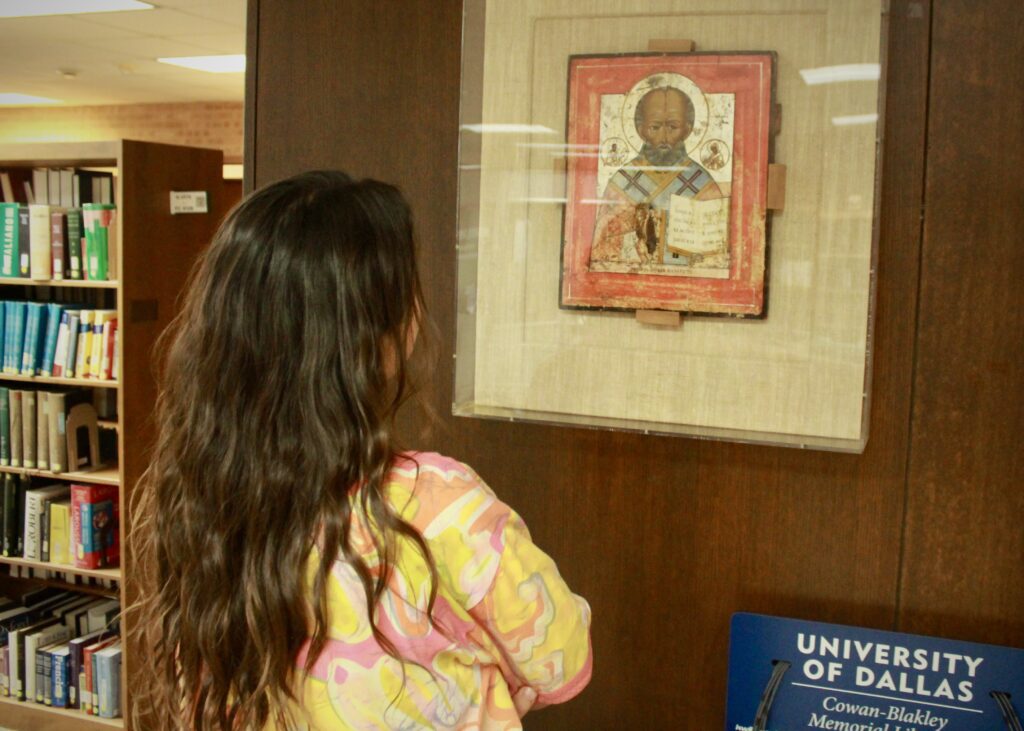
To provide further examples of dramatic and imposing art, the St. Andrew Icon on the first floor of the UD library will take you back to the Greek Orthodox Church of St. Andrew from our Greece trip.
Another honorable mention is the mural of Dante meeting Beatrice, also in the music department. The scene recalls memories of Florence, Italy (Dante’s elusive homeland) but could also be seen as a setting in Irving, Texas, since the flora there are so similar to those found right here on campus.
Each of these hidden gems reveals how beauty quietly weaves itself through the University of Dallas’s campus, waiting to be rediscovered by those with eyes trained by Rome — or simply open to wonder. From the intimate Madonna in the chapel to the radiant mosaic Virgin in Catherine Hall, from the imposing St. Andrew Icon to Dante’s age-old encounter with Beatrice, these works remind us that sacred and classical art are not confined to distant galleries or study abroad trips. They live here, quietly enriching our daily paths if only you have eyes willing to see them. So next time you pass through Haggar, the library or even the chapel’s quiet lavatory, pause for a moment — you may find a piece of eternity glimmering in an unexpected corner of UD.