
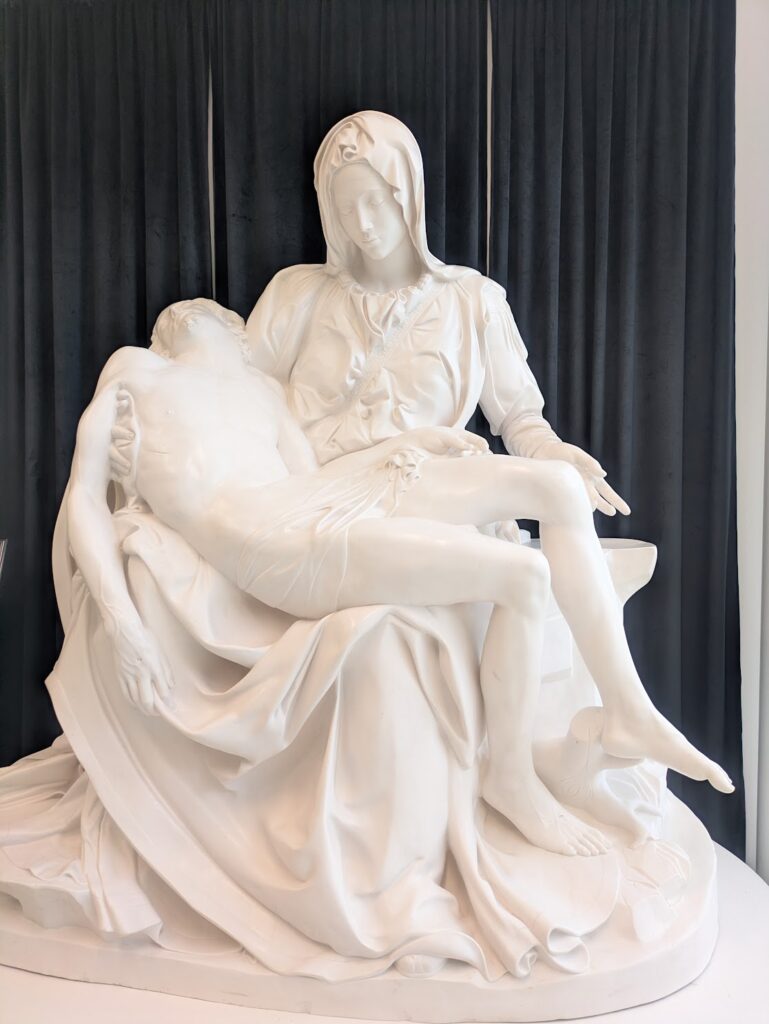
There are many beautiful pieces of art that can be found on campus with each building having their own art pieces that give each building its own charm, and Cardinal Farrell is no different. When students think of Cardinal Farrell, it is “Saint Peter’s Pieta”, a recreation of Michelangelo’s statue of “The Pieta”, that they think of.
Despite the lack of color, it is a statue that is not easy to miss. The detail of the recreation is amazing, ranging from the wrinkles found on Mary and Jesus’s clothing to the veins that can be found on the hands of Jesus. Its size is also what makes it so impeccable, with the statue being lifesize compared to the real thing. The recreation was sculpted in 2009 out of Carrera marble, and was recreated by the Museum of Catholic Art and Library, in Washington D.C.
The original piece is considered to be one of Michelangelo’s many classic Catholic pieces. “The Pieta” was a commission in 1498 by Cardinal Jean de Bilheres, the French ambassador of Rome. Wanting the best for his piece, the Cardinal traveled to Carrara to dig out a slab of marble. Even today, Carrara marble is known to be one of the best marbles in the world. It is distinguished with its white color and the grey veining. It is a material that has been used for thousands of years, dating back to Ancient Rome. The sculpture took Michelangelo a year to finish.
The work depicts Jesus taken down from the cross and laid in Mary’s arms. The name “pieta” translates to “pity” or “compassion”, which is fitting for the piece, as it shows a mother’s compassion and pity for her son, who had just died. The attention to detail is astonishing, even in the replica. One can see the holes in Jesus’s hand where the nails were hammered in and the veins coming from Jesus’s hand. The face of Mary portrays one that is sorrowful as she looks down at her son. Small details that normally do not matter to the average person are perfected, with the folds and wrinkles coming from Mary’s cloak and dress looking lifelike, and the muscles on Jesus defined in the most subtle way, giving a realistic portrayal of the biblical scene. This attention to detail is even more impressive when one realizes that Michelangelo was 23 when he had created this piece. His signature can be seen on the hem on Mary’s Robe. This was etched in after he had supposedly overheard someone mistake the artist for someone else. The signature reads “Micheal agelvs bonarotvs florent facieba”, which translates to “By Michelangelo Bonarroti Florentine”. It is said, however, that he had regretted this decision, seeing it as an impulsive act of pride, which led to him never signing another piece.
Despite “St. Peter’s Pieta” only being a replica, this statue captures the detail and emotion extremely well! Even though it is not the “original thing,” it is still very impressive for what it is, a piece of art that should be appreciated much more.