
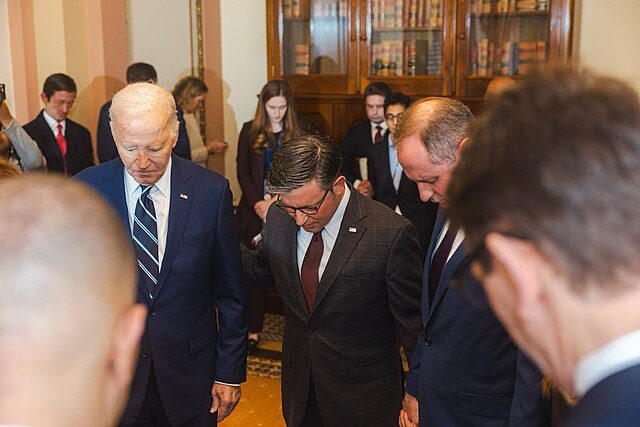
How modern politics falsely claims to embrace the Christian roots of America
Politicians are constantly toeing a thin line when it comes to appealing to both Christian and non-Christian voters, regardless of where they fall on the political spectrum. When trying to win voters and gain support, displaying an extreme view—Christian or not—is risky.
There are some voters who are staunchly Republican or Democrat. They typically hold strong enough views that they can only be convinced to vote for a candidate in their own party. Those running for office already know that they can count on these votes.
The Pew Research Center’s most recent data shows that in 2025, around 40% of voters lay somewhere in the political center. While some might tend towards the right or left, these voters are not “ride or die” Republicans or Democrats.
What ends up really deciding an election is this 40%. These are the people that candidates must appeal to. Those who hover in the political center are typically not the voters with their minds set on voting red or blue. This results in candidates—and even entire parties—loosening up on the more controversial issues—such as abortion— in order to win these votes.
In 2024, the most recent Republican (GOP) party platform was released. While this document did not reinvent the GOP wheel, there were a handful of noticeable changes in stance on some issues typically important to Christians. Most notably, the official platform no longer supports a federal ban on abortion, but rather asserts that the issue should be left up to the states. It also dropped any language that would show an explicit opposition to same-sex marriage.
It’s true that the softening of these stances is what makes Republican candidates more electable. However, any president that publicly calls himself a Christian, and especially a Catholic, while expressing these watered-down beliefs is displaying clear hypocrisy.
The Trump administration typically posts on their social media in celebration of different holidays, many of which are Christian. They’ve posted displays of the Nativity scene on Christmas, and calls for prayer at the passing of prominent American figures—most recently Charlie Kirk.
However, this past Easter, President Trump took to Instagram saying: “Happy Easter to all, including the Radical Left Lunatics who are…”, followed by a list of labels such as “murderers,” “mentally insane” and “drug-lords.”
While I am certainly not one who believes in staying silent in the face of injustice, the use of the day of our Lord’s Resurrection to negatively characterize a group of Americans in such an extreme way doesn’t sit right with me—especially when done in the same sentence as “Happy Easter.”
Unfortunately, Trump is not the only president to display non-Christian values on a Christian holiday.
As you may recall, in 2024 former President Biden—who claims to be a devout Catholic—posted across social media, wishing “those gathering in churches and homes around the world” a happy Easter. He then proceeded to post about “Trans Day of Visibility”—a holiday no true Catholic would approve of.
While Biden’s two posts were most likely aimed at appeasing both sides of the political spectrum, we Christians don’t take well to our worship spaces being used for anything less than holy—Christ Himself was known to flip a table or two, after all.
In this day and age, many politicians claim to be Christian in order to win over what has now become simply another demographic to cater to. If the Bible is not truly being used as a moral compass in policy-making, then it’s clear that it is merely being used as a tool to influence how I cast my vote.
In the words of Shakespeare: “The devil can cite Scripture for his purpose.”