
An Analysis on Love through Paintings
It is difficult to reflect on the visual manifestation of love without being wholly distracted by the romantic affectations it inspires. A lacing of fingers, the tender kiss upon the cheek, those acts which summon the rosy dawn into the face of man and beguile the brain with butterflies.
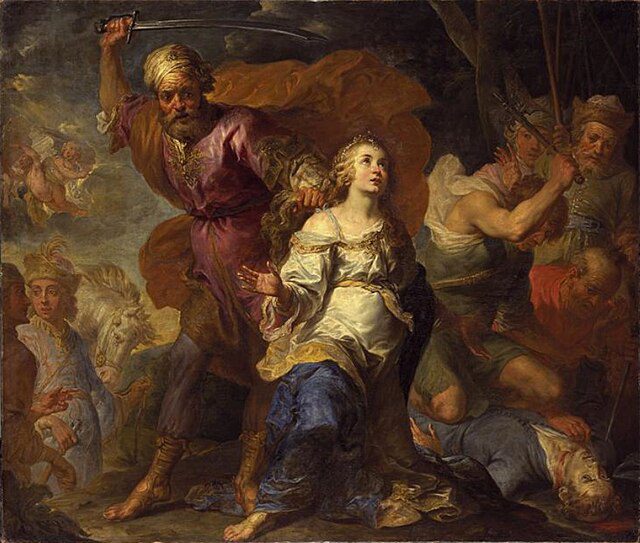
Butterflies don’t appear from the ether, nor do they sprout like roses; they appear first as the humble caterpillars, awaiting the day when they shall enter their tailor-made tomb, the chrysalis and die a little death. With this, we must turn to a painting which captures this strange union between love and death: the “Martyrdom of Saint Dymphna,” by Godfried Maes.
It is a scene of utter violence, with Dymphna’s incestuous father wrenching the girl’s hair in the midst of a decapitating swing, whilst his guards murder the virgin’s confessor, the lesser known Saint Gereberne. This single image not only displays the death of a great saint, but captures both fallen love – which we may call lust – and redeemed love.
Dymphna’s father was infatuated with his daughter because of her resemblance to her mother, and while he suffers from the madness of grief, his affection is only for her physical form. His guard, with seemingly no love for virtue, assisted in his execution of Dymphna and Gereberne.
Such is the nature of lust: clinging, clutching for control, yet inevitably destructive, both to itself and its object. But Dymphna and her confessor represent the opposite ideal.
Dymphna, out of love for her father and for God, refused to comply with an unjust marriage; yet she does not look in anger at her father. Rather, she is seen gazing towards heaven, in utmost longing and trust. As for Gereberne, he loved his spiritual daughter so much that he endured martyrdom alongside her.
In the painting, his eyes look out towards us – the only eyes that do so –, almost challenging us to strive for such ardent love. We should see that this kind of love displayed by both saints is oriented towards God first, and the welfare of the other before oneself.
Another painting, “A Lady’s Favor” by Edmund Blair Leighton, in which a noble lady gives a scarf unto a knight bound for battle, further clarifies the portrayal of love. The knight departs for battle, likely to defend the realm from invasion, setting aside his desire, while the lady promises her faithfulness and love with a token.
This scarf is blood red, an apt symbol for the love shared. Love, redeemed love, can grow when we confront the possibility that what we love might be lost forever; like life in the face of death or liberty under the yoke of anarchy or tyranny.
Neither Dymphna nor Gereberne were mighty warriors, yet they both received martyrdom’s radiant crown by fighting to the end for that which they loved. Where lust ends in death, redeemed love bursts through its bounds, like a butterfly from the chrysalis, and wings through pacific heavens.
From both works, we see that redeemed love, in spite of death, mounts towards heaven, yet simultaneously extends towards others, as fellow monuments of the Maker. This properly ordered love, which fulfills man’s inner longing and fills him with life, is shown through the conduct of the martyrs to be worth dying for.