
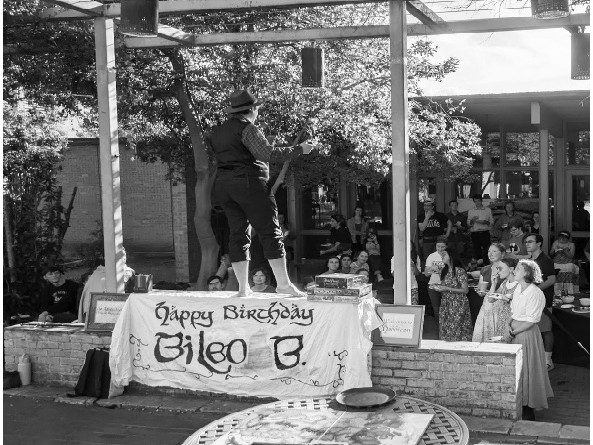
The event kicked off with a wonderful reenactment of one of the opening scenes of the movie “The Hobbit: An Unexpected Journey,” featuring student actors. The scene depicts uninvited guests, the dwarves of the Lonely Mountain, barging into Bilbo’s house uninvited, eating all of his food. The skit ended with the dwarves singing the song “Blunt the Knives,” making for a lighthearted start to the party. Student actors included junior history major Max Muth as Bilbo, junior theology major Seamus Malloy as Dwalin, junior biology major Maddie Zadnik, sophomore history major David Dainko as Fili, junior drama major Heidi Burke as Kili and junior English major Jonas Newland as Gandalf.
Later, Max Muth performed a dramatic reading of Bilbo’s 111th birthday speech from “The Fellowship of the Ring,” the first book in the “ Lord of the Rings” trilogy, receiving lively and enthusiastic reactions from the audience.
“I really, really liked how many people volunteered to host the event, especially the people who helped to put on the performance. Like Max was just willing to drop everything and come to practice for that.” Ruse said. It shows how, despite busy schedules, the performers still wanted to give their all to help others appreciate Tolkien’s work.
After snacking on various goodies, Dr. Hanssen spoke about how one should strive to be a hobbit rather than a wizard. She argued that even though most aspire to be wizards and elves, one should live as a hobbit because hobbits, even though small and simple, have the most potential for heroism.
Hanssen said that even though it seemed as if Tolkien himself thought that hobbits were not significant, because they were too petty and parochial, hobbits play a key role in society in that they are the first to spot evil, even before wizards and elves can.
Hanssen continued and said that Tolkien himself desired to be a hobbit, and called himself a hobbit in everything but size. She said that his admiration for hobbits stemmed from his admiration of what she called “the ordinary Joe.”
Hanssen applied Tolkien’s logic to the modern landscape, encouraging students, whom she compared to elves because of their college education, to listen to the hobbits in their lives, citing examples from UD’s past. Before the professors and students sense anything strange, it is always the humble parents who first notice problems in the system.
“Not in my wildest dreams did I imagine I’d actually get any professors to speak,” Ruse said. “It definitely elevated the occasion.”
Like the hobbits, the Writer’s Guild also started planning the party with very limited means. “We were not given almost any budget in general, and so it was very difficult to make the party special with so little funding,” Ruse said.
The event still saw a large and lively turnout. “I assumed there were only going to be around 20 to 30 people there, but I think we got a lot more than that,” Ruse said.
Ruse attributes the large gathering at the party to be an emblem of “the Tolkien spirit”. “It doesn’t matter how good the event is, everyone is going to show up for their favorite book series,” she said. People dressed up in their best costumes, and even initiated fun activities such as swordfighting and playing “Lord of the Rings” themed board games.
Ruse said that Tolkien and his works are “basically part of [UD’s] identity even though it is not officially part of our identity.” She emphasized that it was the people which contributed to the party’s success. “It was the community, specifically the community of Writer’s Guild, and how everyone pitched in, that made it the best,” she said.
Ruse invites everyone to join the Writer’s Guild, which meets every Thursday from 6-8 p.m. She recommends Writer’s Guild for “anyone who feels a calling towards the worlds inside your head” in order to cultivate a spirit of creativity and to set out on a grand adventure, just like Bilbo did.