
Does religious freedom apply to those who might abuse it?
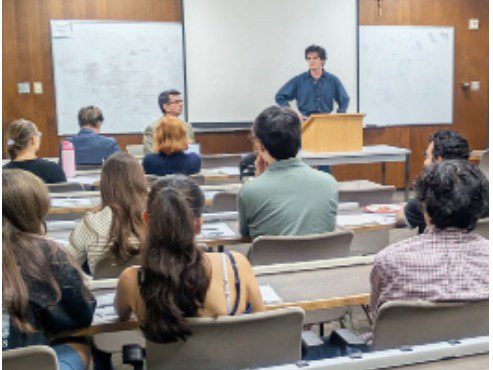
The most recent Young Americans for Freedom debate, which took place on Oct. 5, asked the question, “Is Islam compatible with America?” With conflicts in the Middle East as well as debates surrounding immigration, this question matters to many Americans.
In a Parliamentary procedure moderated by professor of politics Dr. Philip Harold, six students debated this topic, three in the affirmative and three in the negative. Four speakers had speeches prepared, while the last two were impromptu.
The speakers defending Islam were freshman business and politics major Justin Miller and sophomore politics and biology major Shadyna Gordon.
Miller began by mentioning the freedom of religion, one of the founding principles of America: “Anybody can practice any religion they want.” He continued by calling attention to America’s foundation of diversity, and how it is a great strength. Miller said, “The more new ideas we have, the more innovation that can be made. And Islam is a big part of that.” He also drew attention to the number of college graduates who are Muslim. He says that he sees a peaceful, coexistent future.
The second affirmative speech came from Gordon. She opened with a study from Philips-Global: “Ninety-three percent of Muslims are peaceful […] and a radicalized three percent are driven by geopolitical grievances and foreign policy concerns, not religious piety.” She said that Americans must be able to differentiate between different types and interpretations of Islam. Otherwise, Americans risk homogenizing a religion of around a billion people.
She called attention to the Constitution of Medina of AD 662, a Muslim community founded by Mohammad that granted religious freedom to Jews. She also mentioned Muhammad’s farewell speech, which admonished racism. Gordon said, “The existence of imperfect followers does not prove that underlying religion is incompatible with American values.”
Also, there are many civic Muslims who participate in American life. For instance, Mohammad Salman Hamdani was a Muslim first responder who died during the 9/11 attacks. The negative speakers were David Ernie and Blake Stone. Undeclared freshman David Ernie began with a quote from an unknown speaker, saying that “The Bill of Rights is not a suicide pact.” Freedom of religion is incompatible with one of the main tenets of Islam, Ernie continued. He said, “Some of the strongest core principles of the Islamic faith are that the religion supersedes all state governments […] Under Islam there is no government, there is only Islam.”
He said that although many Islamic people are not violent, all Muslims must believe, because of the Quran, in violence against non-believers. Ernie said, “By the letter of the book, those [non-violent Muslims] do not constitute what a true Muslim is.”
The second speaker on the negative side was Blake Stone, an undeclared freshman. He divided the question from Muslims being good Americans, conceding that there have been good Muslims. However, he said, “In terms of Islam itself, on its own values, I do not believe that [Islam] can be Constitutionally compatible.” He drew this conclusion from the treatment of women and homosexuals within Muslim communities. In comparison with Christianity, which has de-institutionalized, Islam has too many violent practices to integrate well.
The next two speakers were impromptu, with the first being sophomore politics major Robert Heyne. He noted that American Founding documents call Catholicism into question. John Jay specifically believed that “Papists” could not integrate because of their loyalty to the Pope. Heyne argued the ability of Catholics to conform to American values could happen in Muslim communities.
The next speaker against Islam was senior business major and YAF treasurer Kathleen Roset. She said, “I want to bring up Great Britain, where Islam is coming up in pockets, and there are towns in England where there is no Western rule of law.” She argued that the Islamic population in Britain is not well integrated. Thus, Islam cannot merge well into a comparable democratic society, like America. “Under Sharia Law Code, women need to be fully covered and cannot go anywhere without a male escort, along with other rules.” These rules seem enforced in Muslim communities.
In the end, the debate was well-received. Some said that they “enjoyed the personal opinions and specific arguments.” Others praised the research done on both sides.
Overall, the respectfulness and thoughtfulness were praised most of all. However, there was no real consensus reached. Despite this, attendees seemed to walk away from the debate feeling satisfied, with several asking when the next debate would take place.