
In September, Pope Leo XIV took a four day trip to France, the first papal visit since Pope Benedict’s visit in 2008. His visit to Paris, Lourdes and Metz presents a monumental shift against the country’s secularization.
France has a profoundly secular modern identity, but has a history deeply intertwined with the Church. The pope’s visit presents a question: how can a country with heavily declining rates of religious practice still have Catholicism so deeply embedded within their history and culture?
For much of its history, France was one of the most influential Catholic countries in Europe. The first Holy Roman Emperor, Charlemagne, established the relationship between Christianity and the political powers of Western Europe.
In the following centuries, the Church and the French state were deeply intertwined, with religious figures such as Cardinal Richelieu, advisor to King Louis XIII, holding significant political influence.
The political standing of the Church shifted dramatically during the French Revolution. The Revolutionary government wanted to dismantle the institutional power of the Church and bring it under control of the government.
During the Reign of Terror, under Maximillian Robespierre, anti- Catholic campaigns intensified. Public Catholic worship was made illegal, churches were closed or repurposed and clergy faced execution. The relationship between the church and state had fundamentally changed.
The conflict eased when Napoleon Bonaparte signed a concordat with Pope Pius VII to restore Catholic worship and a formal relationship with the Church.
Catholicism never regained its prominent political position in France. In 1905, the French government officially separated the church and the state. It established laïcité, or state secularism, as the defining stance of the French Republic.
Despite this separation, France remained a predominantly Catholic country for much of the 20th century. Religion still shaped how people raised their children and lived their daily lives. Over time, this distinction between religious practice and heritage became increasingly apparent.
According to the French Institute for Demographic Studies (L’Institut National D’Études Démographiques), 51% of people aged 18 to 59 identify as having no religion. Within the Catholic community, only 27% of people say that religion is important in their lives, with only 8% attending Mass at least once a month. Catholics have the lowest level of religiosity when compared to other religions in France. Although Catholicism is still the dominant religion in France, identifying as a Catholic does not guarantee active practice.
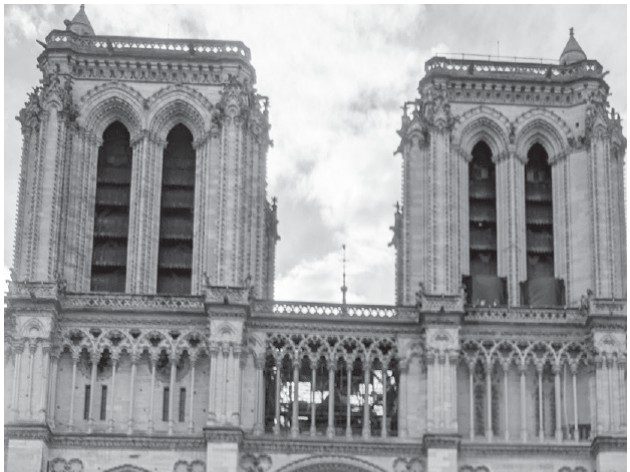
Despite this shift, Catholicism still remains a significant part of France’s cultural landscape. Historic churches and cathedrals, like Notre Dame and Sacre Coeur, remain major tourist attractions.
Several Catholic holidays, including Easter Monday, Ascension Thursday, the Assumption and Christmas remain national public holidays. Catholicism’s influence still extends to those who do not identify as Catholic.
That being said, how can a country experiencing such decline in Catholic practice retain so much of their cultural Catholic identity?
The pope’s visit is an interesting event for this very reason. While in France, he met with political leaders and practicing Catholics, celebrated Masses and engaged with French society. Massive crowds greeted him at every public event.
Yet the number of people who turned out for his visit does not necessarily reflect the strength of religious belief in France. Some attended out of faith, while some probably attended out of the historical significance of the event.
Ultimately, French Catholicism cannot be understood as just a religion in decline. Although its political influence has declined, its influence remains highly visible.
The pope’s visit illustrates this paradox; Catholicism still commands the public attention of an increasingly secular country. A decline in religious practice does not automatically erase the influence of religion.
In my opinion, Catholicism in France is increasingly becoming a heritage and identity, rather than primarily a religious practice. It no longer dominates France the way it once did, but remains embedded in the traditions and architecture of the country.
France’s relationship with Catholicism has changed, rather than disappeared, leaving a country of people whose cultural identity is intertwined with a religion that most people no longer widely practice.