
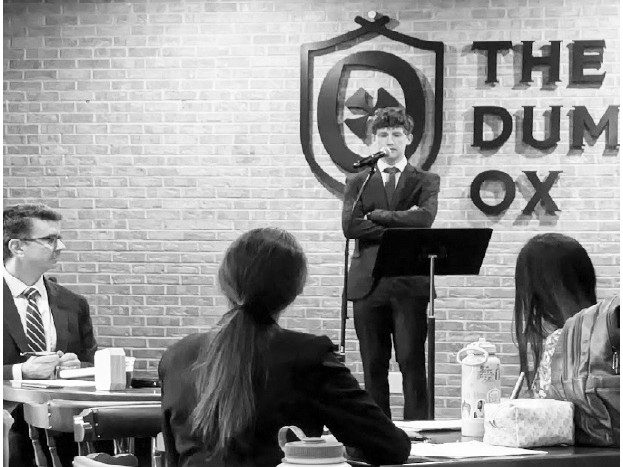
On Oct. 8, the Civic Fellows, a new program consisting of 11 freshmen and dedicated to instilling leadership qualities in its members, hosted a debate on whether praise and worship music is conducive to a healthy relationship with God. Interviewing Dr. Philip Harold, the co-chair of the Civic Fellows program, and freshman Comparative Literature major Lucy Rubach and freshman Theology major Analiese Smead, two Civic Fellows who prepared speeches for the debate, showed more about both who the Civic Fellows are and the debate they organized.
Harold and Dean Whittington created the Civic Fellows program to help cultivate leadership on campus. “The purpose of the program is to benefit the entire student environment by giving a little bit of instigation for students with leadership potential to fulfill it,” Harold said. “We’re not there yet to start a whole center, but putting little pieces of it together.”
Harold gathered the Civic Fellows the day before Orientation to introduce them to one another and let them get a head start in getting to know the University of Dallas.
As part of the program, the Civic Fellows are taking a one-credit course with Whittington this semester to learn about leadership. “[The course] has really motivated us to dig deep into who we are and how that affects the way we lead,” Rubach said.
As the Fellows knew each other before the semester began thanks to the program’s design, the sense of community aided the Civic Fellows during their debate. “It lowered the stakes for the debate because all of us knew we were engaging in friendly conversation,” Smead said. “We’re trying to arrive at the truth together, and not trying to be hostile to each other.”
The Civic Fellows discussed several possible debate topics before sending them to the student body in a survey. The most popular topic, on praise and worship music, was selected for the debate.
The Civic Fellows were pleased with the winning topic. “We thought that the issue would be divisive on a Catholic campus because a lot of people have strong opinions on praise and worship music,” Rubach said. “We thought it would be divisive enough to draw a crowd, and that it would also be low-key.”
Despite the low stakes, the Civic Fellows also recognized the importance of debating the topic in the first place. “It was interesting for people because there is that realization that yes, externalities like music and other forms of art do end up having a deep impression on us,” Smead said. “We come to try to arrive at the truth of what exactly that does for us.”
The parliamentary style allowed the debate to be open, and made it easy for debaters to share what they had to say. “It was very inviting for people to come up and share their opinions. They felt like it was a safe space to talk about what they actually thought, and also a place for them to explore their own logic,” Smead said.
The audience was so engaged with the topic that the debate, which was originally supposed to be only an hour long, was extended for 30 minutes to allow more people to speak. “I don’t know that I’ve ever been at an event where we extended it another 50% in length to popular demand,” Harold said. “I thought the contributions in that last half hour we did that we weren’t planning on were amazing.”
At the end of the debate, Harold invited the audience to offer criticism and improvements. Some of the audience wanted the premise of the argument to be changed somewhat, and said as much at the debate. Smead agreed with the sentiments of the audience, and said, “I think, as a lot of people at the debate said, that the term praise and worship music probably needed to be defined slightly more, and also the resolution itself was a little broad.”
Despite the flaws in the resolution, Harold thought the debate was very successful. “It was the best debate we’ve had on campus, in my opinion,” Harold said. “It’s just a testimony to the care with which the topic was chosen and the job the debaters did, and the students who came and participated.”