
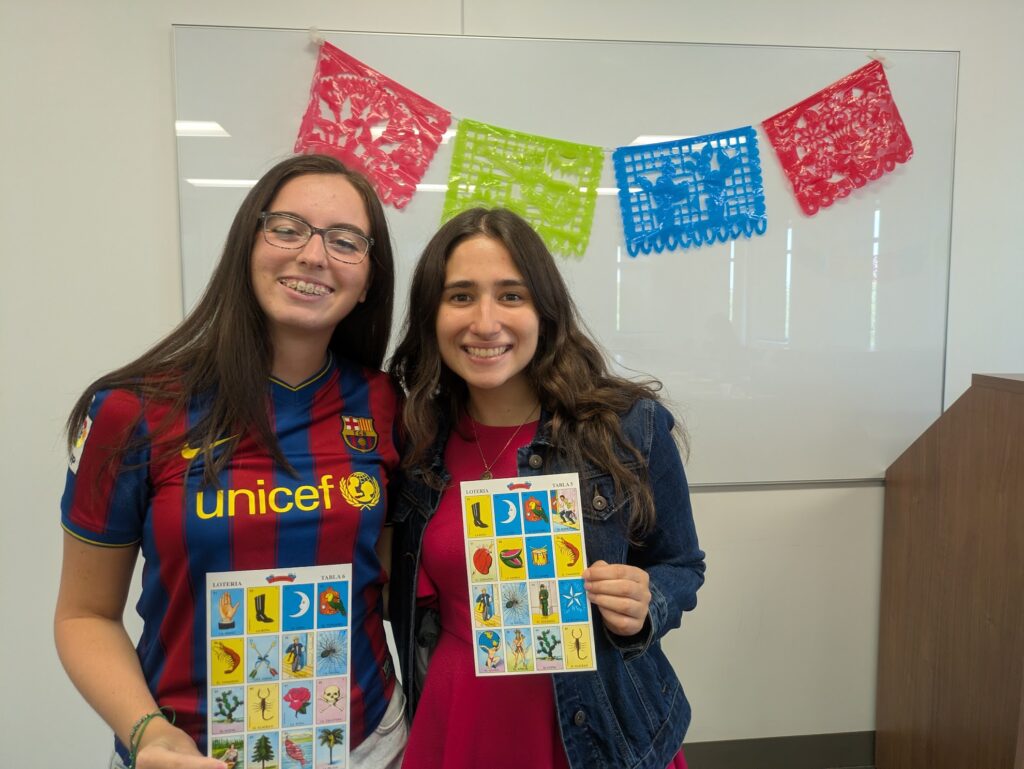
Celebrating Hispanic Heritage Month
The United States is one of the most diverse countries in the world today, with cultural communities from different corners of the globe living on its land. With an entire month to celebrate its contributions and influence on the country, the Hispanic community demonstrates its cultural dominance.
The rich heritage of the Hispanic community, however, is not limited to the food we eat or the exotic dances we perform. The heritage of a community is best perceived in its people.
Hispanic culture is varied even in itself. Belén Martínez and Clara Mollo share their experiences of being raised in Mexican and Argentinean cultures, respectively.
Belen said that Mexican parties are livelier and with more varied music. They taught her to “never leave the dance floor” until the end. Clara spoke about good Argentine music, from rock to reggaeton, which inevitably made Argentines feel better than everyone else (although she herself does not possess that characteristic).
Both mentioned Hispanic American humor, which is very dark and heavy, to the point where their American friends don’t understand it (though they may be missing out).
Andrea Camarillo, a Mexican-born freshman at UD added a different opinion to the idea that culture shapes us,
“It’s more the people that influence you than the culture… than the country itself. She asserts that many of her principles and values come more from her parents and family than from Mexico itself.
Mollo states visits to Argentina with her parents sparked her curiosity to learn more about Latin America in general. Being born into a Hispanic (or foreign) family does not result in living in a bubble.
Furthermore, Mollo feels that seeing her parents struggle to study in another language makes her sympathize with others for whom English is a second language. Martínez is grateful to her parents for being strict in raising her, as this helped her to understand her healthy limits.
However, something important that all three recognize as drastically different from the United States is the sense of community that exists in Latin America. In both Mexico and Argentina, it is a custom to greet everyone when walking down the street; to strike up a conversation with a stranger while waiting in line for food; to complain about the government with the taxi driver during the ride, etc.
It is common for strangers to bond because they are all part of the same community. In the United States, on the other hand, it is common to isolate. “Americans are more independent individually,” said Clara.
But this is not universally true throughout the United States.
Camarillo had not experienced the feeling of communal unity until this year when she came to UD. “UD specifically has people with manners… kind people who make you feel seen,” she said..
Martínez and Mollo have also noticed that people at UD are more united and interested in each other than at their other schools. Camarillo adds that many of her principles come from her Catholic faith , which is predominant throughout Latin America, and which are also heavily present at UD.
.
Culture, therefore, is not something dependent on country or land, but rather on the people, education, and religion children are raised with .
Martínez, Mollo, and Camarillo celebrate their cultural heritage and recognize that there are marked differences between them and Americans. However, they also see many shared customs and leave space for merger between the two worlds to build the beautiful continent we live on. Many Hispanics are excited to find similarities with Americans, because after all, we live on the American continent.