A Look at Our Female Full Professors
Dr. Laura Muñoz, Professor of Marketing
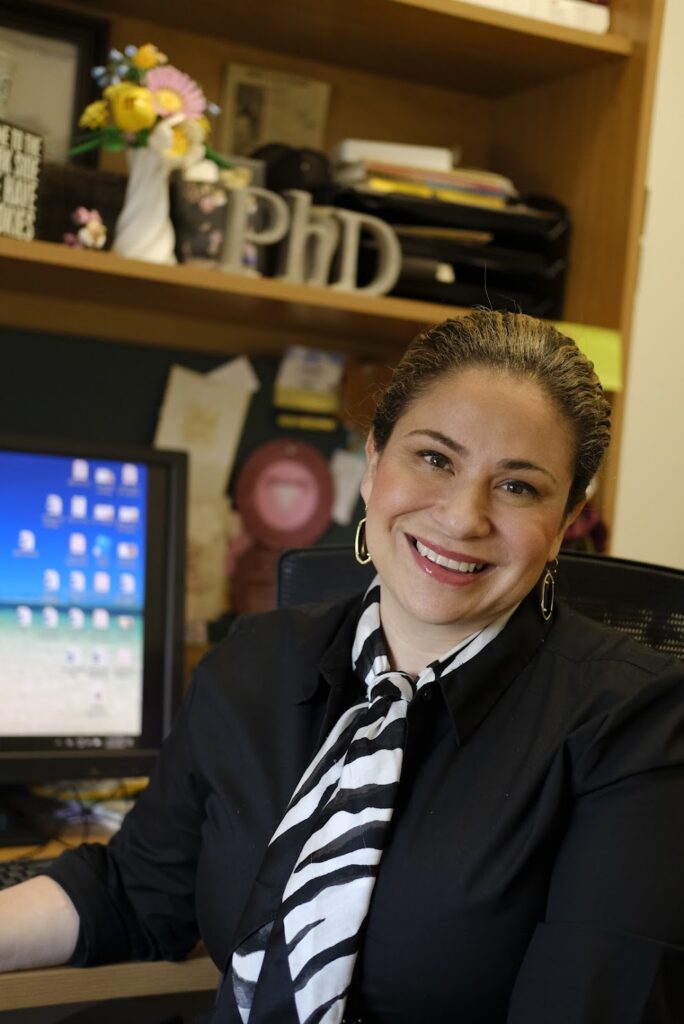
Dr. Muñoz was originally from Mexico and vividly remembers telling her parents that she’ll be right back. Little did she know that life had other plans.
After working as an auditor at the University of Texas Rio Grande Valley, her alma mater, Muñoz was offered a full time position. She did not even consider getting a PhD.
“Everybody’s very educated in my family,” Muñoz said, “And I just didn’t want to. I was like, ‘No, I want to do something else.’”
But her roommate convinced Muñoz to apply to the doctorate program, and she got in. That led to a difficult choice: play it safe and stay an auditor, or take a risk and go to graduate school.
“I came to the realization not only that I was not happy as an auditor, but also I wanted to be challenged,” Muñoz said. “And I’ve always wanted to study marketing, because my undergraduate degree was in accounting.”
As a result, she quit her job and became a full time PhD student, where she found fulfillment and purpose. After she graduated, she taught at UNT Dallas, until a job opened up at UD, a place where she always wanted to work.
Muñoz applied and within a few months, she was hired. This upcoming August will be her fourteenth year working at UD.
Muñoz’s story of how she became a Full Professor is also an example of how women can level the playing field in academia.
“Many people don’t advocate for themselves, and especially women,” Muñoz said.
Because Muñoz recognized the importance of advocating for herself, she negotiated and got in writing that she did not want to lose her time as an Assistant Professor at UNT Dallas, and she started out as an Advanced Assistant Professor at UD. Within three years, Muñoz was approved unanimously for tenure and became an Associate Professor. However, Muñoz recognized that it was not enough for her.
She continued to work, publish and network. She said: “People think that negotiation — that networking — it happens when you need something, and it’s actually the opposite. You network when you don’t need anything, so by the time that you need something, you truly have friends and acquaintances who will be there for you.”
By the time that Muñoz came up for Full Professorship, it was unanimous. It’s no wonder for us as students, and we are so grateful to have Dr. Muñoz at UD.
Dr. Elizabeth Robinson, Professor of Classics
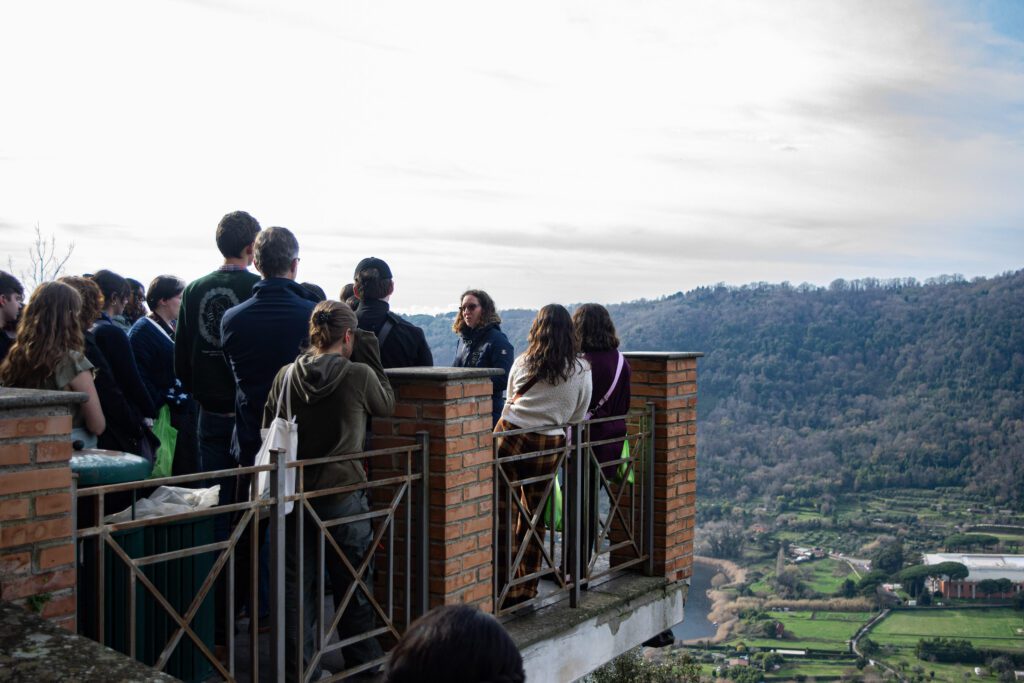
Dr. Robinson graduated from Bowdoin College with a physics degree and a minor in classics, but a piece of advice from one of her physics professors convinced her to change course.
Robinson noted: “[He] said, ‘Look. If you think you want to go to grad school, make sure that you’re really passionate about it and that you have questions that keep you up at night because when you get to grad school, you’re going to hit a wall at some point.’”
“As enthusiastic as I was about physics, I didn’t feel like it was keeping me up at night the way that classics was,” Robinson said.
After graduating from Bowdoin College, Robinson entered a post-baccalaureate program at the University of North Carolina at Chapel Hill. There, she was able to audit archaeology classes and take a course with the professor who would become her PhD advisor.
“I started to actually see what a future could really look like in grad school in classics,” Robinson said. “And so I applied to a bunch of different programs and got into multiple ones but decided that the University of North Carolina at Chapel Hill would be the best fit for me.”
When Robinson worked on her dissertation, she applied for and won a Fulbright fellowship that enabled her to study onsite in Italy. From there, Robinson won a two-year fellowship at the American Academy in Rome, and there, she taught at the American University of Rome.
“Then after that, in between the first and second years of being at the American Academy, I met the man who’s now my husband, who’s Italian,” she said. “So I had a little bit more incentive to stay in Italy, and I applied for another off-campus dissertation fellowship and won that. So I was in Italy from 2012-2013, and then at that point, I started looking for jobs.”
Robinson had just one piece of criteria: she wanted to teach onsite.
She heard that UD was hiring and contacted Dr. Peter Hatlie, Professor of Classics. After a campus visit in Irving, Robinson was able to get the job that enabled her to teach onsite. Ever since, UD students have been able to take the iconic Art and Architecture course with her, for which we are so grateful.
Dr. Debra Romanick Baldwin, Professor of English
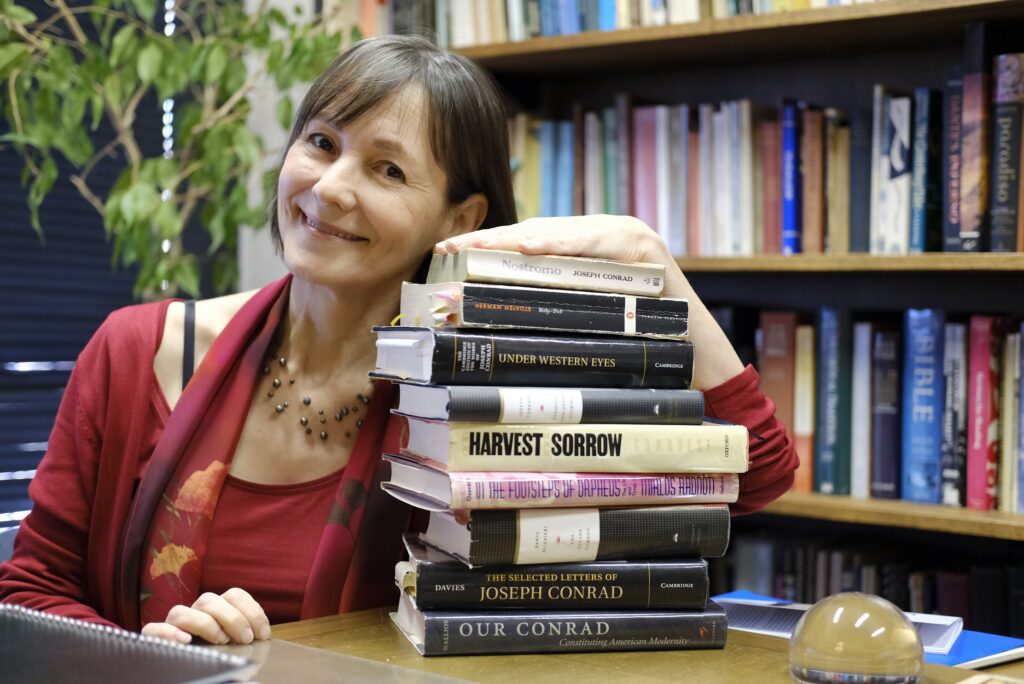
Originally from Canada, Dr. Romanick Baldwin studied philosophy and politics in college, not English.
It was that excitement of learning new things and asking questions that led Romanick Baldwin to go to graduate school, but she realized that there was something about literature that was unlike philosophy and politics.
“[Literature] was a way of seeing the world that captured the most truth of my experience,” Romanick Baldwin said. “It was the thing that gave me the language and the means to notice and express with the greatest detail — all that filled me with the greatest wonder and love.”
Through her experiences in literature, Romanick Baldwin encountered Joseph Conrad, the author who later became her main area of expertise. She said: “Conrad was a writer who seemed to combine my early philosophical interests with my later love of form and language.”
This combination allowed Romanick Baldwin to pursue what she truly loved and to convey that love to others through teaching. Despite her love of teaching, Romanick Baldwin never expected that she would end up in Texas.
Yet there was something about UD that amazed Romanick Baldwin. She said: “I was so impressed by the students, by the faculty and by the Core […] it’s been a wonderful decision to be here at UD.”
Regarding International Women’s Day, Romanick Baldwin said: “I can’t help but think of my mother’s own example […] My mother was a medical doctor who loved her profession. She always said that she thought women should be able to have women doctors. It was exciting for me as a child to see her office, to see her enthusiasm and to hear the good that she did.”
Like her mother, Dr. Romanick Baldwin is an inspiration to us all.
Dr. Theresa Kenney, Professor of English
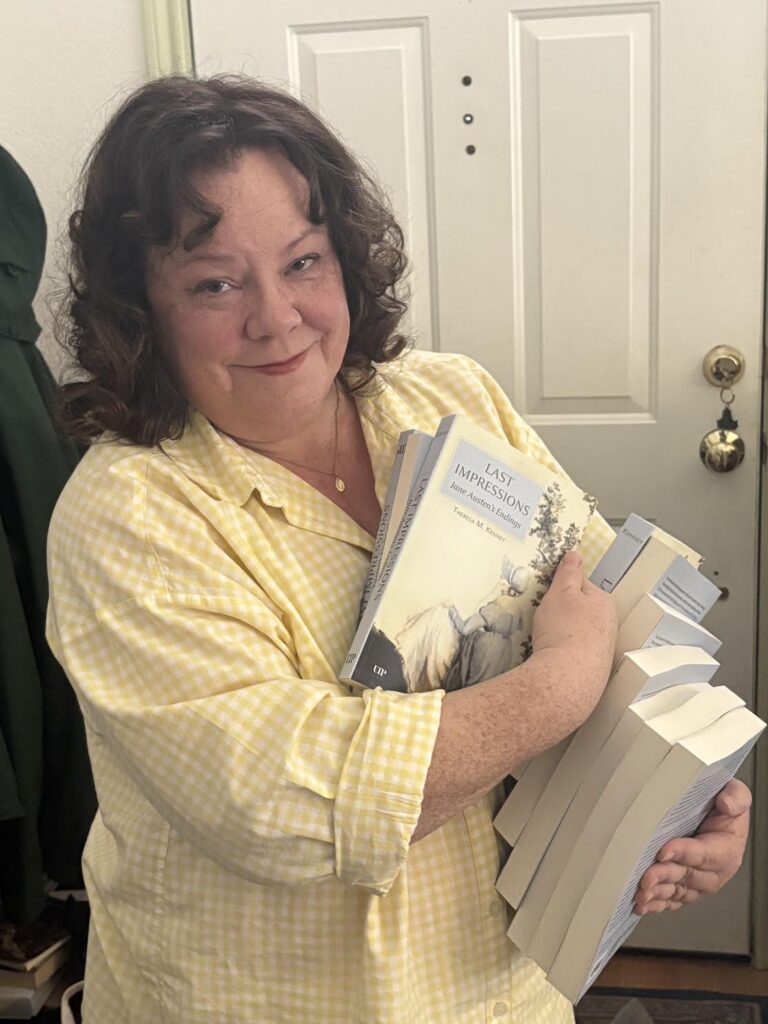
When she was younger, Dr. Kenney never thought that she would end up as an English major.
She said: “When I was graduating from high school, I wanted to be a language major, and I had an offer from Fort Knox to work in their language program because I had taken Russian (I think they wanted me to be a spy).”
Rather than being a spy, Kenney chose to attend Penn State and to major in French, (hoping to double major in Italian and triple major in classics) but that did not last long.
She took an upper division Milton course during her freshman year because friends of hers said that Dr. Condee was going to be retiring.
“I got roped in. That was it,” Kenney said. “I had a very boring French teacher, and I had a really brilliant English teacher, and I ended up as an English major, so I also majored in classics.”
But when the time came for graduate school, Kenney had to choose: classics or English? She ended up choosing English.
Kenney had several different offers from grad schools, but she chose to go to Notre Dame. However, Notre Dame lost their Renaissance professor, leaving Kenney with an uncertain future, so she applied to Stanford for a PhD and got in. Even so, Kenney did not know what her path would lead her to.
“I went to Stanford intending to write a dissertation on Chaucer and Boethius, but didn’t,” she said. “I ended up writing my dissertation on nativity poetry, and then I was taking many courses from Professor Rene Girard.”
Through Girard, Kenney discovered the University of Dallas. She said: “He [Girard] came to UD to do the McDermott Lecture Series, and he came back, and he was just glowing. He was so excited about the University of Dallas, and he said it could save Western education.”
“I thought, ‘Well, that sounds good,’” Kenney said. “And then the next year, I was applying for jobs, and guess what was in the job advertisements? University of Dallas. So I applied, and I asked for my usual reference people. Unbeknownst to me, Rene Girard wrote me a reference. He just wrote it without my requesting it and sent it in. So I interviewed here and got my job here, and that was thirty years ago, and the rest is, as they say, history.”
For those who do not know, Dr. Kenney is a jack of all trades. She not only knows all about medieval literature, but also about Jane Austen and the nineteenth-century novel. We wish you a fruitful sabbatical, and we look forward to seeing you on campus again!
Dr. Bernadette Waterman Ward, Professor of English
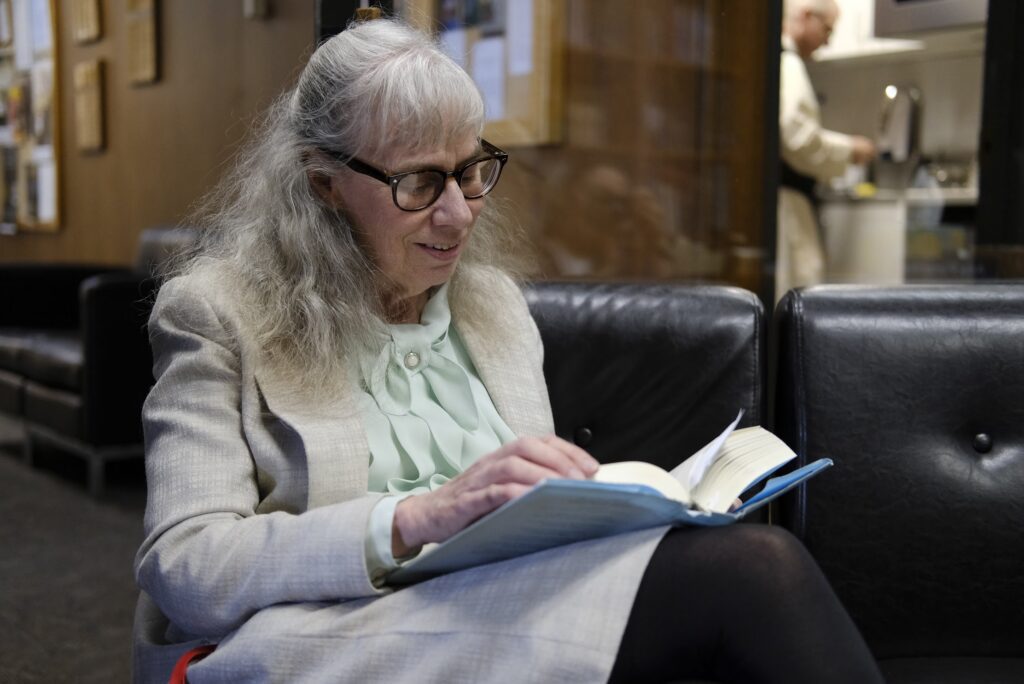
Many elements of Dr. Waterman Ward’s career have come as a surprise to her.
Waterman Ward got into Harvard and went there. She said: “I really loved it. The library has everything. It’s wonderful…It was a much freer place than it is now, and you could have any sorts of opinions and debate them.”
After getting her doctorate at Stanford and writing her dissertation on the contrasting philosophies of the poets Matthew Arnold and Gerard Manley Hopkins, Waterman Ward taught at the State University of New York for 10 years. However, she said: “I wanted a place that had more academic integrity, which is why I ended up here.” Unsurprisingly, her favorite class to teach is on Hopkins and philosophy.
Waterman Ward has been teaching at UD since the fall of 2000. She was made a Full Professor four years ago.
She said about working in academia: “It’s important to find yourself a place where you have collegiality, where you feel comfortable […] You want to be with people who care about what you care about and actually do care about it.”
To young women considering entering academia, Waterman Ward said: “One way that you can really mess up your life is to defer, thinking about that [marriage] until after you’ve got your PhD. No, live your life, live your life in grad school, and then if you get an academic job, hurrah. And if you don’t get an academic job, you have a life.”
To young women considering entering academia, Waterman Ward said: “If you get into academia, then hold your ground […] Don’t compromise yourself.”
Dr. Waterman Ward has written two books, one on George Eliot and one on Gerard Manley Hopkins, as well as several plays and many articles. She is also this year’s King Fellow. We at UD are so thankful to have her.