
Art, amongst its myriad designs, aims to re-present — namely, to bring us unto its subject or bring its subject unto us. When that subject is a man, however, human expression is tested to its breaking point and thus a focus on particular element results.
Such are the origins of adaptation, the dialectical art in which great works are expanded and expounded, and Christopher Nolan’s own contribution to the mythical man of many ways, Odysseus, is one of these. Nolan’s work follows an ancient tradition, but the exact nature of “The Odyssey” as an adaptation demands our consideration as scholars and inheritors of the Epic.
We must address three crucial areas in our appraisal: technique, memory and the audience. Only through these may we understand the many ways within the film, and the odd destination where it leaves us.
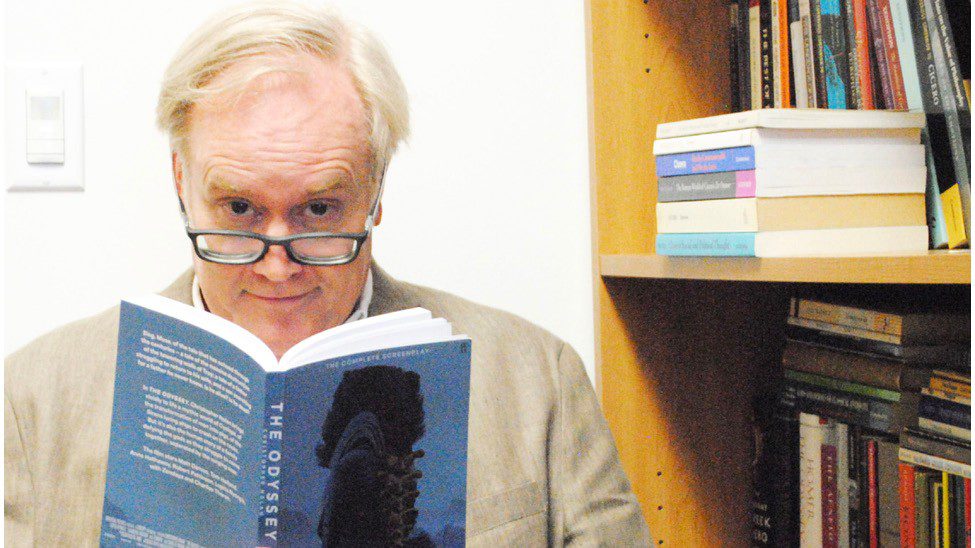
In light of the complexity, professors from the University’s English and Classics departments were interviewed to provide their perspective on the film as a work of art, an adaptation of its inspiration and as a cultural landmark.
“The Odyssey,” as with many other Nolan films, excels in technique — a thing which has made Nolan’s name time and time again. As Dr. Teresa Danze, chair of the Classics Department explained: “The Trojan Horse is an exquisite and majestic piece of art […] half sunk in the sand, it’s ominous and beautiful.” Turning to the infamous cyclops, she said, “Polyphemus looks nothing as one usually sees him portrayed and the allusion to Goya’s “Saturn” as he eats one of Odysseus’ men is a great touch.”
The multifarious techniques employed by Nolan serve far more than a practical purpose, as Danze noted, placing the work in the grand schema of art ranging from Homer’s great song to American film, which frames the movie as a broader critique of mankind and culture. Dr. Scott Crider, professor of English, emphasized that, “[‘The Odyssey’] is clearly not a mere cinematic illustration of Homer’s epic, but a creative interpretation of the source material.”
Crider further explained that, “Many of [Nolan’s] most interesting and successful changes — the kind that drives purists crazy and encourages snobs to pretend to know the poem better than Nolan does — draw upon the long tradition of reworking the epic in later literature.” Nolan is attempting to draw our eyes outward, both back to the source material and forward for our own odysseys ahead.
However, Nolan’s film, in my view, fails when it comes to memory, something reflected in its dialogue and characterization. Danze particularly criticized the scriptwriting, and said, “The writing was utterly vapid and obvious, and full of unearned, worn out sententiae — the gods help who help themselves.”
Furthermore, one can’t help but notice that the Odysseus in the film differs wildly from that of Homer. Crider points out that, “in many ways, he resembles Aeneas more — Nolan and [Matt] Damon catch Odysseus’ endurance, his ingenuity and his suffering, but not his polytropic intelligence.”
This is where the audience intersects with the memory, as Nolan’s Odyssey seems written precisely for a modern, culturally American viewer. As Nolan’s dialogue seems closer to everyday lingo we use, and his Odysseus is characteristically American — a wanderer feeling exiled from his home, grappling with a psyche wracked by guilt, with a psychology influenced by the drug-like lotuses… And, changing with the world around him, he moves through time like Aeneas, the Roman.
Nolan’s “Odyssey” does not give us that great Greek warrior, nor the full story of the character who has above all others achieved a literary apotheosis. What it does give us is a plot, predictable yet poignant, of conflict and regret and a Roman memory who walks a western road that leads not unto Rome, but to Nowhere.