
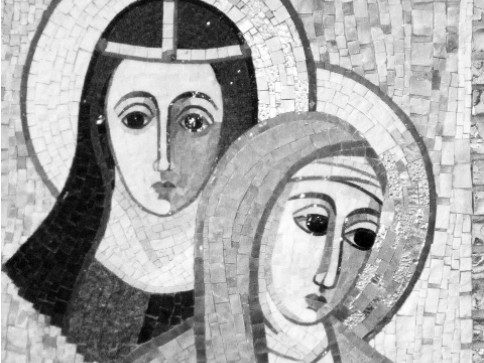
If you have been to a popular pilgrimage site recently, you may have noticed that some of the art, especially certain mosaics, have been covered by banners or tarps. Earlier this month, the shrine at Lourdes began to cover the facade, which holds several mosaics depicting the life of Christ. Even here in America, the mosaics inside the John Paul II Institute’s chapel have been covered for over two years.
This is not a coincidence. The mosaics were created by Father Marko Rupnik, an ex- Jesuit who made over 200 mosaics displayed across churches and holy sites worldwide. He designed the official logo for Pope Francis’ 2015 Jubilee of Mercy, as well as several large mosaics featured in churches across Rome and the rest of Europe.
In 2018, Father Rupnik, a Jesuit at the time, was accused of sexual misconduct involving religious sisters who had worked with him. The next year, the Jesuits held these accusations to be credible and began conducting an investigation. They were not able to determine whether his actions could be considered sexual abuse, but in 2022 they found that he had committed the ecclesiastical crime of absolution by absolving the sisters he had committed sexual acts with, a scandalous and shocking revelation.
Rupnik was excommunicated in 2020 and expelled from the Jesuit order for disobedience. Pope Francis lifted the excommunication two weeks after it was declared when Rupnik repented.
Most of the accusations pertained to alleged events that took place in the 1990s, so no verdict was able to be reached under the 20 year statute of limitations. However, in 2023, Pope Francis waived the statute which until then did not allow a Vatican investigation into his allegations to take place, and began a formal investigation in Rome. At the time of Francis’ death, the investigation was ongoing.
The investigation continues to this day under Pope Leo XIV. In the meantime, the Pope has ordered that all Vatican websites remove every instance of Rupnik’s art. Because of this, churches have begun covering up Rupnik’s mosaics ahead of visits from the Pope — all except one.
Fatima, Portugal, among the most famous Marian sites in the world, has refused to cover up any of Rupnik’s art leading up to Pope Leo’s upcoming visit. They did remove any promotion of his art on their website, but have simply stated that they will not take down or cover his physical art in the shrine.
This has sparked controversy within the Church, and millions of people are asking themselves to what degree art must be separated from the artist. Many believe that keeping the art uncovered disrespects Rupnik’s many alleged victims and perpetuates their abuse. Some go so far as to call the art “blasphemous” or “demonic,” while others hold the principle that art cannot be judged by the actions of the artist, and continue to respect and revere Rupnik’s art as such.
Whether or not art truly speaks for itself is a perennial discussion, but Fatima’s decision to keep Rupnik’s art uncovered has made it a more pertinent question to the Church than ever before. Pope Leo’s decision to remove his art from Vatican websites indicates that Rome does not view art as totally independent from its artist, and the trend of churches covering the art seems to confirm this.
Even the Fatima shrine’s decision to stop the promotion of Rupnik’s art on their own websites acknowledges the connection between art and artist, despite their refusal to cover the physical mosaics.
The strongest opponents of Rupnik’s art are those who never liked it in the first place. Though the mosaics have been likened to the style of ancient Byzantine art, many have found the disproportionate features of the subjects to be off-putting and unlike the ancient art that inspired them. Because of this, there are those unsurprised that the creator of such art would be involved in such accusations.
After all, is it not the case that creators leave something of their likeness on what they create?
As the trial continues, the evidence mounted against Rupnik becomes increasingly undeniable. The heinous nature of his crimes adds an urgency to the situation that leaves no room for pedantic debate. Is the art that was created as Rupnik allegedly abused more than two dozen women redeemable, or should it be removed and replaced with sacred art unassociated with such evil?